
Healthy Relationships: Attachment Styles

Attachment Styles
Have you noticed a pattern in the way(s) you think or act within your relationships? Perhaps you are uncomfortable expressing your feelings, or you often feel a bit jealous, or maybe you are completely comfortable with your partner. One theory that possibly explains these patterns is the attachment style theory. The attachment style theory presents 4 possible attachment styles, which are considered the foundation for how we navigate relationships throughout life. Insecure attachment styles lead to difficulties having meaningful relationships while secure attachment allows people to have healthy close relationships. Although these styles are formed early on during childhood, it is possible to change from insecure to secure attachment styles. Understanding your attachment style can help you understand how to move forward and build healthy long-term partnerships.
Based on the theory, there are four types of attachment styles made up of insecure (anxious, avoidant, disorganized) and secure styles.
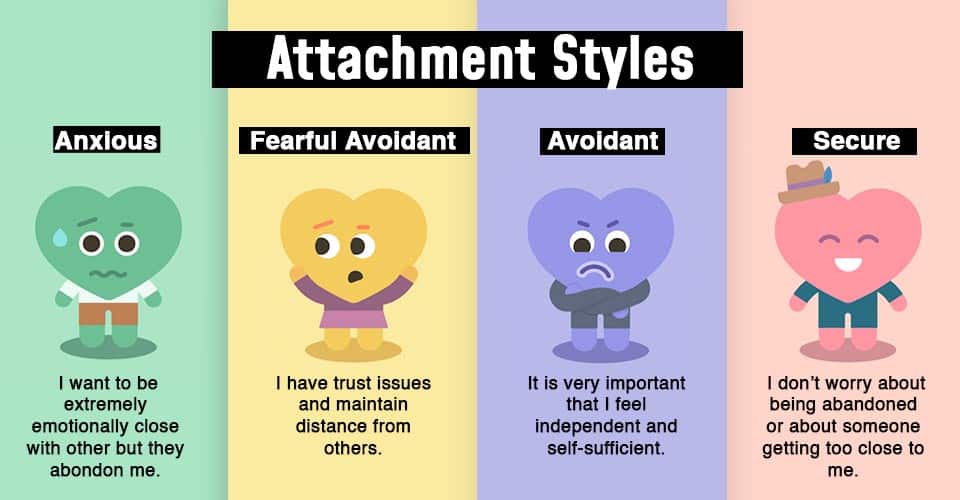
Image from Mind Help
Insecure: Anxious/Preoccupied
Those with an anxious attachment style view their partner as someone to provide approval and support.
Signs of an anxious/preoccupied attachment:
- An anxious attachment style often causes the person to value their relationship but worry that their partner is not as invested as them
- Feeling unworthy of love
- Needing constant external approval
- Difficulty being alone
What it looks like in a relationship:
- Fear of being abandoned which leads to clingy behaviour
- Exhibit intense jealousy which stems from lack of trust or low-self-esteem
Insecure: Avoidant/Dismissive
Those with avoidant/dismissive attachment styles feel that they do not depend on others or need a partner to feel complete (Mikulincer, 2007).
Signs of an avoidant/dismissive attachment:
- Generally, avoid emotional closeness or suppress feelings
- Difficulty trusting people
- Strong sense of independence and not needing others in life
What it looks like in a relationship:
- Dismisses relationship once it becomes too serious
- Lack of emotional intimacy so the relationship lacks depth
Insecure: Disorganized/Fearful-Avoidant
Those with a disorganized/fearful-avoidant attachment have unpredictable behaviour and difficulty trusting others.
Signs of a disorganized/fearful-avoidant attachment:
- Avoid emotional attachment out of fear of being hurt
- Contradictory behaviour
- Difficulty trusting others
What it looks like in a relationship:
- Those with disorganized/ fearful-avoidant attachment styles want a close relationship but have trouble trusting and depending on others
- Unpredictable behaviour due to switching between need for security and fear
Secure
A person with a secure attachment style thrives in relationships but is also not afraid to be on their own.
Signs of a secure attachment:
- Ability to seek emotional support
- Comfortable being alone
- Easily trusting others
- Ability to manage conflict
- High self-esteem
- Comfortable in close relationships
- Able to communicate effectively
What it looks like in a relationship:
- Secure attachment in a relationship is based on honesty and emotional closeness where the person can express their emotions openly.
- People with secure attachment feel that they are worthy of love without external reassurance.
Take this quiz to find your attachment style
Changing your attachment style
Attachment styles can become altered from insecure to secure through personal development. Choosing to take steps to alter your attachment style is most effective as you can work on strategies that help you change repetitive negative patterns. The following strategies are some examples of working towards a secure attachment style.
- Practice acceptance of yourself through self-compassion and building self-esteem.
- Learn to identify and express your emotional needs.
- Avoid reacting and rather take time to process information before deciding how to act.
- Work on learning to resolve conflict.
- Reflect on your relationship and take accountability for how you make the other person feel.
- Work with a therapist to uncover the root of your attachment style and techniques for secure relationships.
Resources on campus
References
Hudson, N. W., Chopik, W. J., & Briley, D. A. (2020). Volitional Change in Adult Attachment: Can People Who Want to Become Less Anxious and Avoidant Move Closer towards Realizing those Goals? European Journal of Personality, 34(1), 93–114. https://doi.org/10.1002/per.2226
Mandriota, M. (2021, October 13). Here Is How to Identify Your Attachment Style. Psych Central. https://psychcentral.com/health/4-attachment-styles-in-relationships
Mikulincer, M., Shaver, P.R. (2007). Attachment in Adulthood: Structure, Dynamics, and Change. Guilford Press.
Simpson, J. A., & Steven Rholes, W. (2017). Adult Attachment, Stress, and Romantic Relationships. Current Opinion in Psychology, 13, 19–24. https://doi.org/10.1016/j.copsyc.2016.04.006
World Mental Healthcare Association. (2021). Attachment Styles. Mind Help. https://mind.help/topic/attachments/attachment-styles/
Relationships